Monday, August 22, 2011

Yes, I Really Am Her Voice

Who knew that advocating for your child could get messier than changing a eleven year old's diapers? It goes to show you, I always have something to learn.
In the current battle over words and an effort to bring attention to how the media handles hurtful "jokes", I found myself defending my position to folks who I thought were on the same side of the issue as I am. I guess even in the community of people that are defending the rights of those with disabilities there is an us against them mentality that I really don't get. Doing the semantics dance with self proclaimed "self advocates" isn't  irritating, it is aggravating. No parent wants to be accused of mistreating their child but to be accused of "placing focus on yourself rather than on the person it should be about" and the fact that I presume to speak for The Princess is so "offensive it makes me want to cry." Unfortunately when I tried to reply, it had become very ugly. It became so bad that the original poster shut down comments making it impossible to respond and leaving whatever was said last hanging in the air. 
How does this happen? How do people who are fighting for the same thing (presumably dignity for people with disabilities) end up fighting eachother instead? If my daughter cannot self advocate, does that give permission for "self advocates" to exclude her or myself from the disability community? Since when does it change me from a tenacious caregiver to an offensive, selfish person? Why is the pain of watching my daughter being mistreated suddenly not appropriate? If I write and speak in defense of her dignity I am harming her in some way?
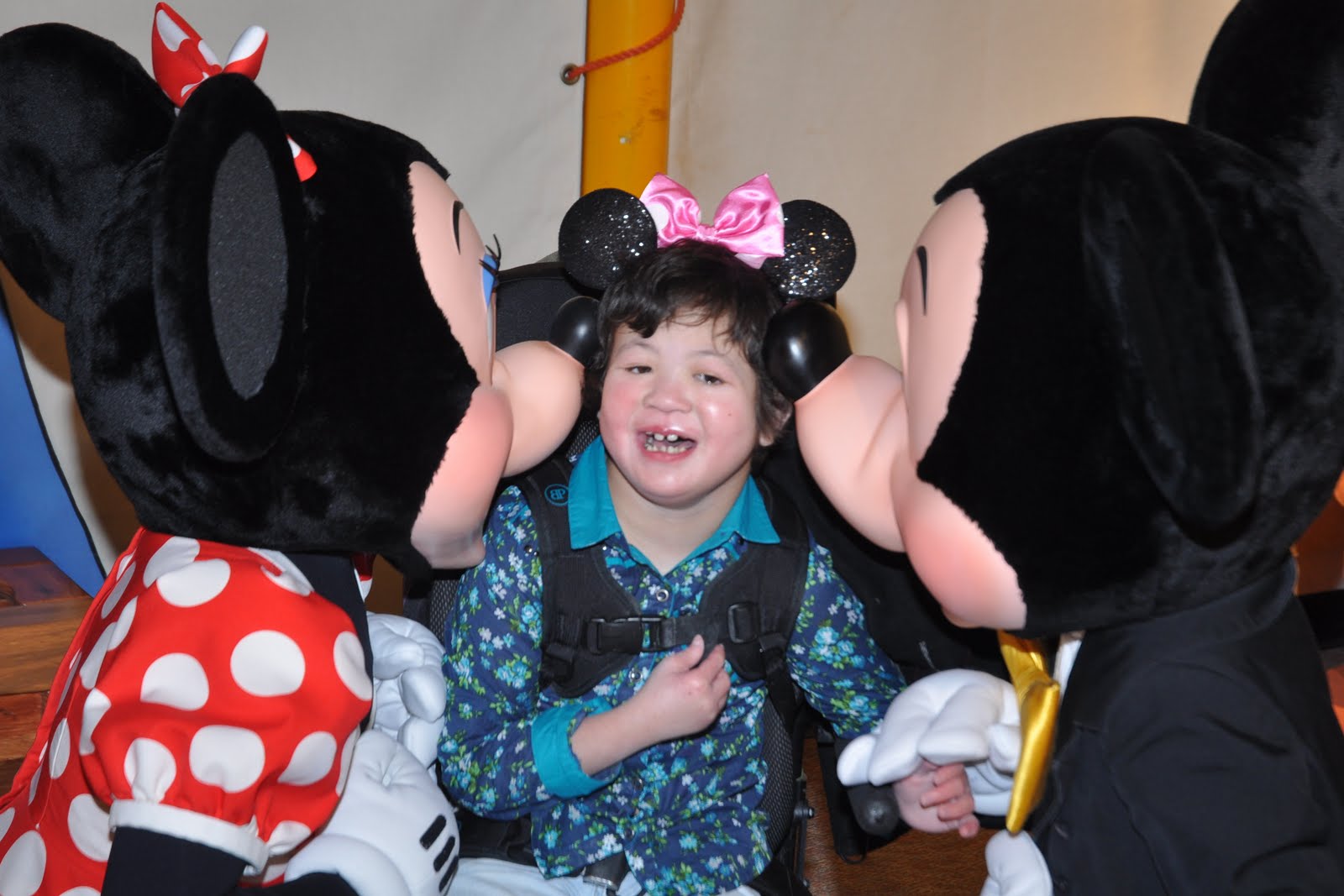
At this point in time, The Princess cannot communicate in either written or spoken word. She cries when she is in pain, she screams when she is mad, she laughs when she is happy and she giggles when she goes fast or sees people dancing. The best comparison would be to say that her expressive ability is about the same level as a 4-5 month old and her receptive ability is around 3-4 years but that is extremely difficult to judge. So it is up to me, The Coffee Guy and any other caretaker to tune in and listen to what she wants or needs. It is at that point that one of us will use our voice to be her "voice".
Dictionary.com defines voice:
noun
1. the sound or sounds uttered through the mouth of living creatures, especially of human beings in speaking, shouting, singing, etc.


There are times when we all need someone to speak up for us. All children need this at birth, some will need it longer than others. Some folks will "tune into her frequency" but most of those providing therapies, services and education don't have that kind of time to tune in, so I speak for her. I am her voice, not her mind, not her emotions and certainly not in this to be "coddled" or have the attention focused my way. I am in it because I was given the gift of a daughter who completely changed my perspective on parenting, friendships, faith, community and value.
Sadly, these "self advocates" are only able to see their own struggles from their own perspective. Not one has admitted to being a parent. I am not in any way (nor have I read where any other parents who were advocating) saying that my struggle equals that of my daughter. What I am saying is that I know her struggle up close. I walk with her (figuratively) through her struggle daily and speaking for her is not something I take lightly.
This type of thing is not just in the realm of families or persons with disabilities, I could list many groups that should be better at working out their differences in pursue the common good. Sadly, some aren't able to let go of their own perspective in order to understand someone else's. We let our tainted view or preconceived notions determine how we perceive others instead of opening ourselves to new possibilities. The irony is that this is what so many of us in the disabilities community fight for continually. We want ourselves, our children or loved ones to be seen as more than their diagnosis or their thought process or even their equipment.
We are all on the same side. We may be standing in different places with our own perspectives but we are fighting the same enemy so we owe it to ourselves and those we are advocating for to join forces with respect and compassion to those who really are on our side. After all, I value the perspective of someone who is able to use their own voice!
Always,


Hope

Monday, August 15, 2011

The Battle Over Words

Last week I found myself actively fighting a war that usually just takes place in my head. The whole conversation about words and the power behind them has had my brain engaged in this battle all week long. Some very thoughtful posts have caught my attention but the comment follow-up has captivated me. As I mentioned in my previous post, the words themselves are not as worrisome as the attitudes that we attach to those words. Many have spoken out on the writings of others with almost a righteous indignation about their "freedom of speech" or about how the parents of exceptional children are being too sensitive. Julia Roberts, the author of this article, points out, "Their “right” to use terminology that offends, even in the face of being educated that it’s hurtful and perpetuates hate and discrimination, is what they want to use, just because to them it doesn’t really mean anything. To them, a joke. They defend with great passion." Like I have said before, if it means nothing to you than why do you spend so much time vehemently arguing to prove your point. 

Here is my point, as a parent to a child who may or may not understand what you are saying, it really matters. We know that speaking encouraging words to our typical children helps shape and mold them. So what about our children who have physical, medical, emotional and intellectual differences? If they already need extra help, doesn't it make sense that taking extra care about what we say to and about them makes a difference?

I read a beautiful blogpost over the weekend regarding what we say to little girls when we meet them. As adults, how we engage our young people is so very important as they grow. After soaking in this well written and quick read, it brought to mind the awkward conversations I have had over the past 12 years when well meaning strangers have approached The Princess for the first time. Funny enough, Julia references a conversation in her article that spun off of another post where parents shared some of the uncomfortable things they have heard over the years. I found myself cringing at the audacity of those who argued that we were all being "too sensitive". Obviously that is how others become callous towards other human beings that they share this planet with.
I'm okay with it though. I grew up being told I was too sensitive because I'm a "major weeper". I'll admit it, I cry a lot. I have come to grips with this horrible character flaw by reminding myself, I would rather be a tender, compassionate human being who passionately enjoys life, than one who can't feel and abhors others who can. I am passionate so I feel deeply, I hurt deeply and I love deeply. In the past 11 years I have been taught by a priceless human being what it really means to trust, to have faith, find joy in the simplest of things and carry no malice. She has endured countless surgeries, procedures and indignities. Her intellectual disability has been used as a slur by political figures, as entertainment in movies and thrown around in public more times than I can count. Yet, if any of those insensitive and proud of it individuals were to meet her in person, she would lean forward in her chair, look them in the eye and give the most beautiful crooked tooth grin imaginable. I still have so much to learn.


Always,


HOPE

Tuesday, August 09, 2011

My Daughter Is NOT A Punchline


Does she look like someone who is fair game when it comes to making jokes? Do you find her disabilities to be funny? I know it is hard to look at her and even imagine that someone would use her situation to get laughs but it happens a lot it makes me angry!


Really, look at her. Does that fact that her condition includes "retardation" even stop and make you think when you hear someone utter the r-word as an insult?


Well apparently Universal Pictures thinks it is just fine. Their movie "The Change Up" starring Ryan Reynolds and Jason Bateman pushes past the limit.

Mitch Planko played by Ryan Reynolds about his friend's twin babies:
"Why aren't they talking? Are they retarded? This one looks a little Downsy."

The one thing I am thankful for is that I found a new blog author who put the whole situation in perspective in a way I never could. He exclaims "All those cinema professionals, and none of them, NOT ONE, ever said "You know, we're making fun of purely innocent, absolutely blameless people here." 
I am not a big fan of boycotts but I have no problem warning you about the small collective intellect that was used to put together this movie. The quality of the humor can't be worth the ticket price or the gas to the theater.


So here is the big deal. Here is what I need to say to those who cry foul when they are called on the misuse of these words. I keep hearing "words don't mean anything". If they don't mean anything to you but they are hurtful to others, stop using them. Robert Rummel-Hudson, author of the above mentioned post said "Freedom of speech isn't the same as immunity from reaction. I wish people understood what that phrase really means."


This is something I couldn't let go of today and I asked myself why. Why am I trying so hard to convince a group of people to be nice. What if only one person reads this and decides to stop using the r-word or becomes sensitive to a comment made for laughs? What if it is passed on to one person who speaks up for the most vulnerable of our society? Then maybe, just maybe that will be one less hurt inflicted on another human being. Possibly one child will be spared the humiliation that a "word" (but more accurately an attitude) can bring.
I can Always Hope.